My son you will never meet
On December 31, at a routine OB appointment, the doctor couldn’t find our baby’s heartbeat.
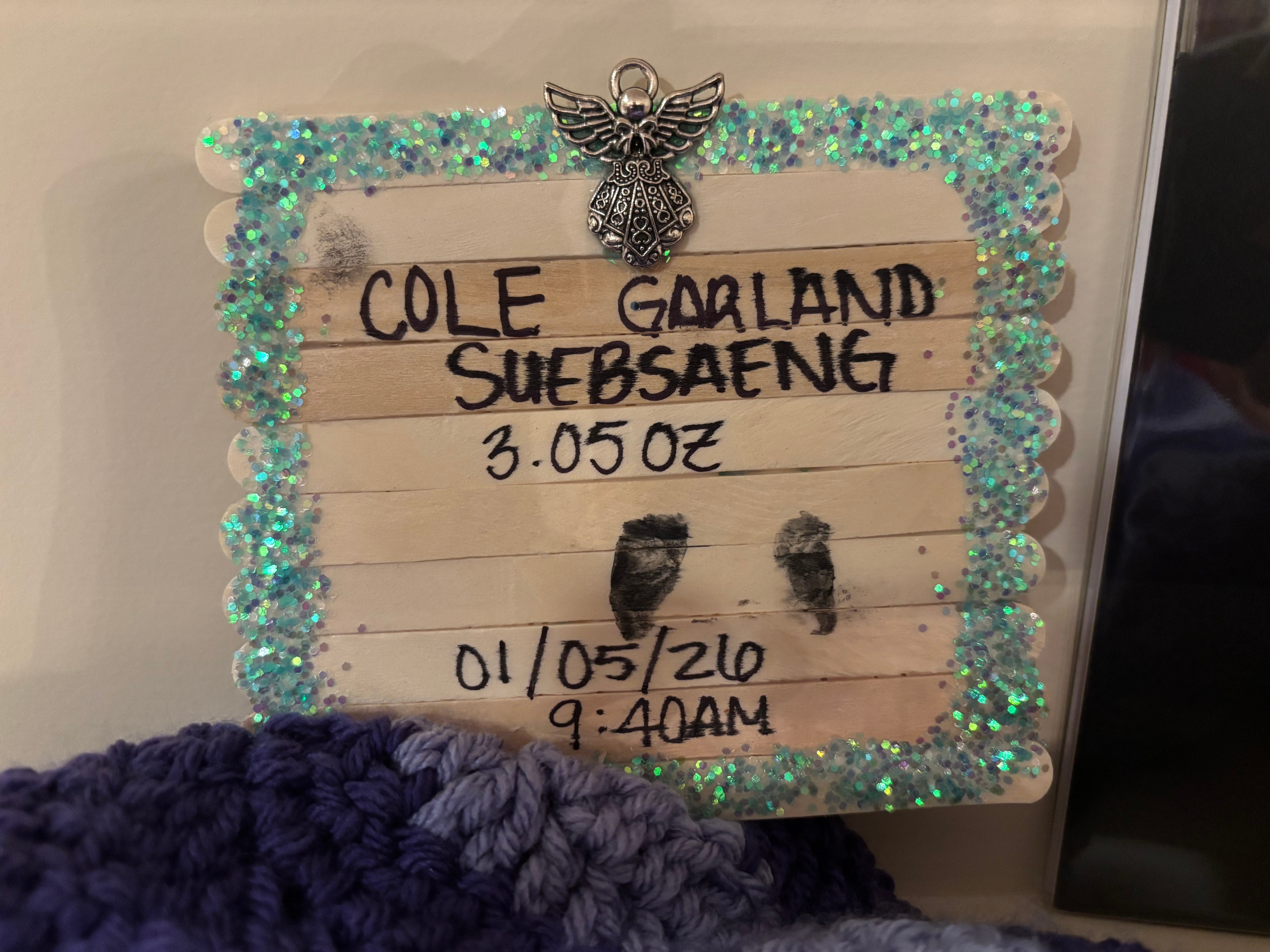
My 4-year-old, Dylan, was insistent that the baby’s middle name should be “Garland.” We had just put up Christmas decorations.
“Tigey” was Dylan’s first-choice name for his future brother, but I had reasoned with him that we already had a stuffed tiger by that name so we couldn’t also call the new baby Tigey. Dylan agreed that “Cole” would be OK as a first name as long as it was followed by Garland as a middle name.
We were not about to make our third son live with a Christmas decoration for a middle name.
But he won’t have to live with it.
So, that’s what we’ve called him: Cole Garland Suebsaeng. Born January 5, 2026.
Died—well, we don’t know, exactly. Before he was ever born. But not before we had grown to love him, and imagine a future for him in our family.
I was nearly five months pregnant. By this point, we had thought it safe to tell our two boys they would have a baby brother. Safe to show them the ultrasound photos and let them brainstorm with us about names. Safe to post pictures online of our youngest son, Jude, in a “big brother in training” sweatshirt.
On the morning of December 31, I shopped The Children’s Place’s post-Christmas sale, snapping up matching plaid attire for next Christmas for Dylan, Jude, and the new baby.
On the afternoon of December 31, I had a routine OB appointment and the doctor couldn’t find the baby’s heartbeat.
I had gone into that appointment breezier than I had been at any previous. By now, several ultrasounds—including one less than a month prior—and prenatal genetic testing had confirmed things were on the right track. We were well past the first trimester. We were good, I thought.
The vast majority of miscarriages do happen in the first trimester, it’s true. But things can go wrong any time—things I had never even thought to worry about.
Like a blood clotting disorder. Mine, not Cole’s. At least that’s what doctors suspect.
A post-birth examination of the placenta showed it full of clots. These can happen with high blood pressure in pregnancy, aka preeclampsia—which I did not have. They can happen with autoimmune conditions like lupus or antiphospholipid antibody syndrome—which I do not have, at least not according to recent test results.
Now they’re testing for more rare blood clotting issues.
If it is that, blood thinners—or even just a regular dose of baby aspirin—may have saved Cole. But we don’t routinely test pregnant women for clotting disorders. (Even when they’ve had three previous miscarriages, including two in the past year.)
Anyway, it may not be that. It may not be anything knowable.
I’m telling you that part because it’s bearable to write about. The basic facts. The known and unknown. The way women are failed by—I don’t know. Maybe the medical system, maybe just biology.
I will not go on about our dashed hopes, our disappointment, and devastation. It is too much to make public. You can guess at all that, I’m sure.
I will tell you that I decided to give birth to Cole by induced labor rather than opt for a dilation and evacuation (D&E) surgery, and I am glad.
I had surgical procedures with of my two previous (first-trimester) miscarriages—the first long ago, the other more recently—and it’s jarring to go under anesthesia carrying a baby and wake up without it.
This way, we got to see him. To hold him. To say goodbye face to face.
That was two months ago.
Since then, I’ve had to go through all the horrors of the post-partum period—milk coming in, hormones fluctuating wildly—while also grieving the fact that I had no baby to show for it.
I’ve had to break the news to Dylan—who had delighted in tracking the baby’s size with me on my pregnancy app, who was I think still secretly dreaming of calling the baby Tigey, who kept asking if Cole would grow up in heaven or stay baby-sized forever—and to Jude, who did not understand.
I am writing publicly about this in part for practical reasons. We publicly announced the pregnancy—on Christmas cards sent to far-flung family and friends, and in (now-deleted) social media posts—and I want people to know what happened without me having to have a million conversations about it.
I am writing publicly about this for, in part, solidarity reasons. So many women experience pregnancy loss, so few talk about it, and maybe we should more.
But mostly, I think, I am writing publicly about this because Cole was my baby, if ever so briefly. And I want you all to know that he existed, and he was beloved.
Elizabeth I’m so sorry. Thank you for sharing this.
Sending condolences and love to you and your family. Though I am a stranger to you, I feel your pain.